

Internet Pioneer: Building One of Retail’s First Web Stores- Part 2
Part 2: My Second Big Bold Bet
Part 1
I figured out early in my career that the trick to accomplishing big bold bets was never allowing your mind to entertain the thought of failure. I’ve watched numerous people over the years blow rare career changing opportunities because they lacked courage in themselves, or mustered the courage but entertained failure as an option. I always picture myself crossing the finish line, striving to exceed the current bar. While some might call this blind ambition, this gift enabled me to accomplish amazing achievements throughout my career. My odds for success were always higher, because I aligned my opportunities with my passion (2 of 2): technology.
In the summer of 1985, after completing an internship with Price Waterhouse, I made my first Big Bold Bet: turning down their job offer because I realized during that internship that accounting was not one of my core passions. I told them I was changing my major to business computing (in my junior year) and helped them see the PC tsunami hitting their beach. My Dad’s gift ( see Part 1 ) had given me the confidence and competence to mentor the entire office on their new PCs that summer. Their brand new consulting division hired me on the spot.
It’s now late summer 1996 and I’m faced with my 2nd Big Bold Bet: I’m on a mission to build one of retails first revenue producing websites, in stealth mode, with no clue how to proceed. But my vision was clear: Ecommerce would not only become a new shopping channel for retailers, it would revolutionize the entire industry in ways I couldn’t yet comprehend but knew were inevitable. I’d presented my case to our board of directors and been shot down – but that wasn’t going to stop me. I’d accurately predicted the wave of personal computing and bet my degree and career on it. And this vision was just as strong, stronger in fact. I had to prove I was right and the opportunity was staring me in the face. I could taste the finish line….
Keep Your Eye on the Target
I love coding and don’t get intimidated by taking on a new forms of it, although I’ll admit, HTML seemed pretty strange. The concept, however, of pushing a button and having that code immediately accessible to the entire world was exhilarating. It fueled my passion to a level I’d not yet experienced before. I was insatiable, and poured myself into the task at a pace that surprised even me. That is, until I hit a wall. This was pretty new stuff, I was doing this under the radar, and I only had so much time to devote to it. Despite my conviction, the challenge was daunting and I began to feel my confidence wavering. But fear is a powerful motivator if you don’t allow it to consume you. Somewhere along the line I’d learned to harness fear and convert it into motivational energy, perhaps on stage as a young drummer. Then I remembered a trick I’d learned as a programmer in college during a semester I was learning the programming language Pascal. I’d hit a similar wall during an assignment, and after beating my brains out trying to solve a problem, I headed over to the computer lab to seek help. I ran into a guy that suggested I post the problem in a Pascal “forum” on Compuserve. I was vaguely familiar with forums, which are essentially chat rooms focused on a specific topic. I gave it a try and to my amazement received a brilliant solution the next day from some geek that apparently had nothing better to do. Through those forums I also learned that sometimes, in a crunch, it’s better to “borrow” good code than invent it depending on your end game.

Know Your End Game
My end game now wasn’t to become the best web developer, or change my career to web design. I just needed a website, and fast. So using this cool new thing called a search engine (there were several out by 1996 including infoseek, Yahoo, eXcite, and altavista – Google didn’t launch until 1998) I started scouring the web for a decent website foundation I could “borrow”. I was stunned by what I found, discovering that the web was an endless reservoir of unlimited information and access to a network of people who seemed to know everything or someone who did – all for free in real-time. Within days I abandoned the books and stole the base structure for the site from a variety of sources. From that point it was a matter of branding the site and loading the relevant company and product information. By Sunday night of the following week, I’d not only built my first website, I’d built one of the first retail websites on the internet.
Just Sitting In Cyberspace
While basic and not flashy by today’s standards, the Bombay Company website was live, and I had no idea what to expect. It just existed in cyberspace – no launch, no fanfare, no marketing. The statistics at the time suggested that most people “surfing the web” didn’t fit our customer demographic, which were women in their 30’s to 50’s. In 1996 there were approximately 100,000 websites on the internet, accessible via dial-up modems ranging in speed from 28.8Kbps to 33.6Kbps – my current speed is 2GB!! The biggest internet service provider was AOL with five million subscribers who mostly viewed this new medium as an electronic newspaper with chat rooms. Most people never ventured outside their ISP’s website as there wasn’t much of interest beyond their gated walls. I didn’t really care as I considered myself in learning mode. I started off small to test the water and get a feel for this new digital playground. I had a home page with some basics like our store locations, a small segment of our latest catalog (without the option to buy), investor relations, general company info, and two forms for user submission. One allowed people to inquire about working for the company, and the other was a simple form open to any inquiry or feedback. I’d casually mentioned to a few department executive administrators like legal, HR, store operations, and merchandising that I was running an “experiment” and that they might be receiving emails from customers seeking help or guidance on occasion. They were intrigued, but didn’t ask too many questions and were happy to help.

Seeing Was Beyond Believing
I’d let my inner circle of direct reports in on my little secret by now and they were beside themselves with excitement. Most loved the fact that I liked pushing the envelope with new technologies. Weekly during status meetings we’d review our website host provider’s statistics which included the number of hits and their IP addresses which gave us a general idea of where these people were geographically located. For three weeks we got nothing which didn’t really surprise us. We started exploring strategies for how we could expose the site to our customers without raising too much internal attention.
And then we got the week four report.
Astonishingly, not only had we started getting hits, but they were coming in from all over the world. I’d figured that we’d get hits from the forty states in which we had stores, but never dreamed we’d get hits internationally. We’d been “pinged” from Italy, France, Germany and England – but incredibly also Egypt, Iceland, and South Korea. We were stunned and bewildered. This was unexplainable, inconceivable. We spent days trying to figure out how this was possible and came up with nothing. By the third day we’d secluded our little geek squad around pizza, coffee, and intense conversation behind closed doors in my spacious corner office. My executive assistant became suspicious and eventually burst into my office demanding to know what was going on. We explained the situation which she pondered for a moment then, with a smile, said simply “well it seems pretty obvious to me. These are bored military wives with access to this internet thingy, craving a piece of America”. We were speechless. She was right, and in that split second I realized I’d been right: The retail industry and our lives would never be the same. And I’d just proven it.

Technology’s Cool. Politics Still Suck
I shared my stunning discovery with our CEO Bob Nourse and CFO Jim Herlihy, and while slightly miffed that I’d gone rogue, they were completely blown away by this retail miracle. They struggled to comprehend how it was possible, but green-lighted me to test selling a few products online. My instincts told me that Bob was beginning to see the long term potential which was extremely gratifying for me. While our sales barely reached a dozen units within the first few months, my concept for using our catalog call center for order fulfillment worked like a charm. My big bold bet had paid off, and I couldn’t wait to take one of retails first web stores to the next level. I contracted Microsoft (I was a groupie at that point) to begin creating a “professional” website on their newly launched Microsoft Site Server. They admired my vision, and were equally impressed with my passion (and balls) for both technology and retail. Ironically, the relationships I established during that project would land me a job at Microsoft in 1999. I worked there for 14 years, rubbed shoulders with the most important retail executives in the world, and achieved my goal of shaping the future of retail.
Just weeks before my planned website expansion, my world came crashing down.
On September 5th, 1996, I received the stunning news that our founder Bob Nourse and his wife Aagje had been fired by our board of directors. They claimed it was declining sales, but I was convinced it was a political hit job. Chairman Carson Thompson who replaced Bob as the new CEO had pulled a coup in my opinion because he wanted the job. I was devastated. While Bob was the entrepreneurial genius that launched “America’s hottest company” according to Inc. Magazine, who named him Entrepreneur of the Year for 1993, Aagje was the classy merchant genius with an incredible eye for style. She had revamped our product assortment in the late 80s and was a driving force in the company’s rapid growth. They were a great team and I greatly admired both of them. Especially Bob, who was brilliant and extremely approachable. It was Bob’s instinct in the infamous board meeting (see Part 1) that inspired me to shrug off their prediction that “this internet thing” was a fad and prove them wrong. Bob and Aagje were the heart and soul of The Bombay Company, and our soul had just been gutted.
A Devastating Twist. A Game-Changing Turn.
A year later, miserable, I was sitting in Carson’s office enduring a lecture on why my IT department was “a necessary evil”. Carson was clueless about the rapidly expanding importance of technology in retail and hated technology. He was furious that I’d taken it upon myself to prove him wrong and he wasn’t hiding his anger. I was screwed. There was zero chance that he would allow me to expand my vision and I felt hopeless. To make matters worse, a few weeks later the board fired our CFO Jim, my friend and retail mentor.
Just as I was blazing a visionary trail into retails revolutionary future, my vision was shattered into a billion bits and bytes.
Follow the Fellow Who Follows a Dream
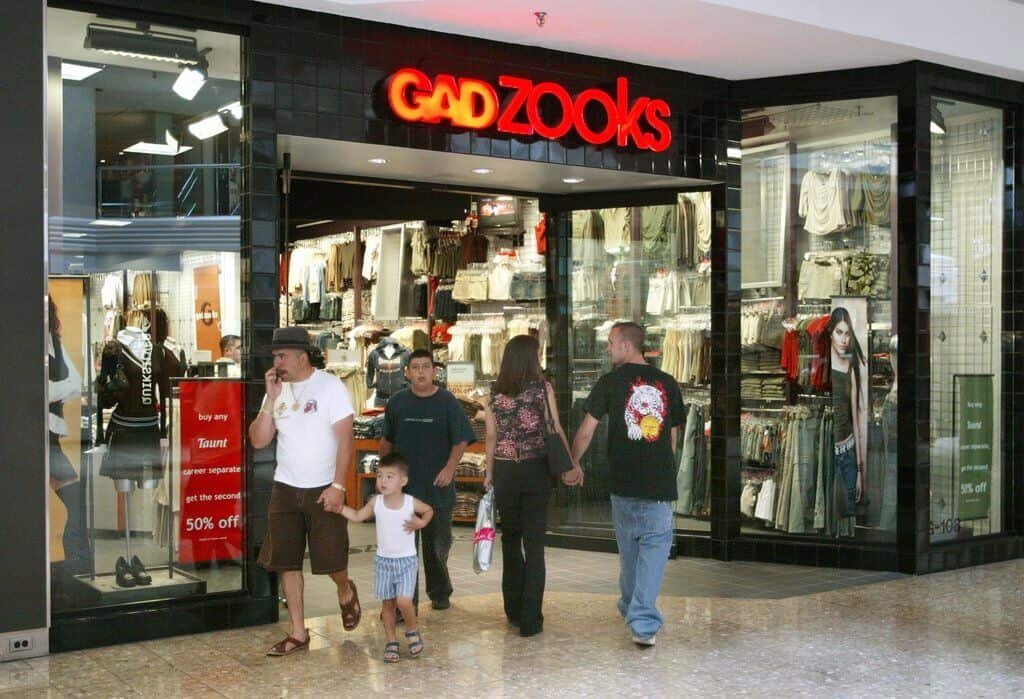
When I look back throughout my career, I’m awed (and quite grateful) by the number of “lucky breaks” and perfect timing moments with which I’ve been blessed. As I’ve said before, it’s awesome when opportunity’s door swings open, but it takes confidence and guts to walk through each door. What appeared to be a devastating blow at the moment turned out to be a huge stepping stone into retails whirlwind future. Bob Nourse was on the board of a very cool, young, high-energy specialty retailer called Gadzooks Inc. They offered trendy fashion to teenagers, and while smaller than The Bombay Company, they were growing rapidly and could no longer function on their shoe-string technology infrastructure. They needed a technology overhaul and Bob recommended that they hire a visionary Chief Information Officer to architect a technology foundation that could support the company’s anticipated growth. And he knew just the guy. I was miserable at The Bombay Company and ironically Gadzook’s headquarters was just ten minutes from my house. In early 1998, they approached me for their new CIO position and it was an offer I couldn’t refuse. A sizable increase in salary and a 120 minute commute reduction with a new baby on the way was the icing on the cake. A year later Microsoft called and asked me to help them become credible in the retail industry and build their first retail consulting practice. My first day at Microsoft was June, 7th 1999 – my youngest daughter’s 1st birthday.
My technology career was finally catching up with the only speed I’ve ever known: Mach 9 With My Hair on Fire….

Thanks for the feedback Jim. Yes, those were amazing times. I had many fond memories at Bombay. Hope you are well.
It is a great read and a nice trip down memory lane! Jim W